
How to teach kids AI at home starts in ordinary moments. Your child is at the kitchen table doing homework. They open ChatGPT, type a question, read the answer for about four seconds, and copy it into their document. Then they close the laptop and tell you they are done.
You are not sure what just happened. You are not sure whether to be impressed or concerned. And you are definitely not sure what to do about it.
This is why how to teach kids AI at home has become one of the most practical questions parents face right now. A child with access to a powerful tool and no adult in the room asking the right questions. Not because parents do not care, but because most parents do not know what the right questions are.
This article shows how to teach kids AI at home with those questions. You do not need to be a tech expert. You do not need to understand how AI works under the surface. You need twenty minutes and a habit of curiosity, and you can start tonight.
How to Teach Kids AI at Home Without Creating Dependence
OECD research published in 2026 found that when AI replaces a child’s thinking entirely rather than supporting it, those students can perform worse once access is removed than peers who never used AI at all. The tool did not make them smarter. It made them dependent.
The first rule of how to teach kids AI at home is that the difference between those two outcomes is not the tool. It is what happens around it.
A child who uses AI alone, types a question, reads the answer, accepts it, moves on, is developing a habit of dependence without realising it. The AI does not tell them their prompt was unclear. It does not flag that the answer was shallow or biased. It gives them something that looks finished, and it often does so with a tone that sounds confident and complete.
A child who uses AI with a parent present, and with a parent asking questions about what the AI produced, is developing a completely different habit. They are learning that the output is a starting point, not an ending. They are learning to evaluate rather than accept. They are learning something that transfers far beyond any specific tool.
A parent learning how to teach kids AI at home does not need to know more about AI than the child. They just need to be present and curious, and to ask the questions that make the child do the thinking the tool skipped.
“The parent does not need to know more about AI than the child. They just need to be present and curious, and to ask the questions that make the child do the thinking the tool skipped.”
How to Teach Kids AI at Home Without Being a Tech Expert
Here is the simplest methodology for how to teach kids AI at home. Three questions. Ask them every time your child uses an AI tool, regardless of which tool it is, regardless of what they are using it for.
- What did you ask it? This question surfaces whether the child’s prompt was clear or vague. Most children type in a rushed, imprecise question and accept whatever comes back. When a parent asks them to explain what they asked, the child often realises for the first time that their question was not very specific. That realisation is the beginning of better prompting.
- Did you think that was a good answer? This question builds the habit of evaluation. Most children do not ask themselves this. They read the output, it looks plausible, they move on. Being asked whether it was good forces them to apply their own judgement. They start noticing when the answer missed the point, when it was too generic, when it stated something they know to be wrong. That noticing is the most important skill in AI education.
- How would you make it better? This question builds the habit of iteration. Instead of accepting the first result, the child has to think about what was missing and try again. This is the core of what educators call AI fluency. Not using AI, but directing it, questioning it, and improving the result through their own thinking.
Those three questions, asked consistently, are the core of how to teach kids AI at home because they turn any AI session into a learning moment. A parent who does nothing else but ask these three questions every time their child uses an AI tool is doing more for their child’s AI education than most schools are doing right now.
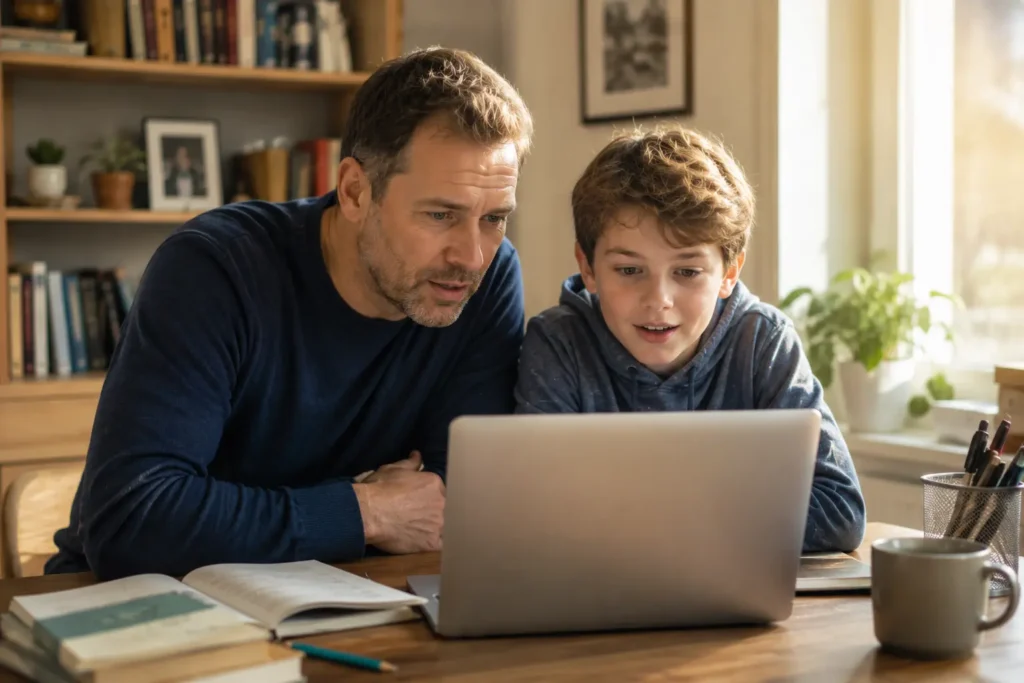
“A parent who does nothing else but ask these three questions every time their child uses an AI tool is doing more for their child’s AI education than most schools are doing right now.”
How to Teach Kids AI at Home in Practice
When thinking about how to teach kids AI at home with a younger child ages 8 to 11, the session does not need to be long or formal. Sit beside them when they are using a tool like ChatGPT, Canva, or Suno. Let them do something they are interested in. When they show you the result, run through the three questions naturally. Keep your tone curious rather than critical. You are figuring it out together.
A useful starting point for this age group is Suno. Ask your child to describe a song they want to hear. Listen to what the AI produces. Then ask: was that what you imagined? What would you change about the description to get closer to what you wanted? That loop, describe, listen, evaluate, refine, is the same cognitive process that makes every AI tool valuable, and it takes ten minutes.
When deciding how to teach kids AI at home with an older child ages 12 to 16, the conversation can go deeper. When they use ChatGPT for a school task, ask them to show you two versions, the first output and the improved version after they pushed back on it. If there is only one version, that is the starting point for the conversation. Why did you stop there? What did you assume was good enough? Those questions are harder, and they are exactly the ones worth asking.
A useful exercise for this age group is to take a piece of work they did with AI and ask them to identify three things the AI got right and one thing it got wrong or missed. Most teenagers have never been asked to critique AI output this deliberately. The first time they do it, they often find it surprisingly easy, because they knew more than the AI about their own topic. That realisation changes how they relate to the tool going forward.
Tools That Help You Teach Kids AI at Home
For children ages 5 to 7, start with Google Quick Draw. The AI guesses what the child is drawing in real time, often hilariously wrong. It requires no setup, no account, and no guidance. It just shows a young child that AI makes guesses based on patterns, and sometimes those guesses are wrong.
For ages 8 to 11, Suno for music, Canva for image generation, and ChatGPT with a parent account are useful when learning how to teach kids AI at home because they produce the most natural learning conversations. Each one produces a visible, shareable output that makes the three questions easy to ask.
For ages 12 to 16, how to teach kids AI at home can shift toward ChatGPT used independently once the three-question habit is established. Gemini is worth adding as a comparison tool. A teenager who notices that ChatGPT and Gemini give different answers to the same question has already learned something most adults have not yet worked out.
For a full breakdown of tools across every age group with more detail on each, the guide to best AI tools for kids by age covers this comprehensively.
For the question of when a child is developmentally ready to start, the guide on what age should kids start learning AI covers this.
What Teaching Kids AI at Home Can and Cannot Do
Consistent practice with how to teach kids AI at home builds one thing above everything else: the instinct to question AI outputs rather than accept them. That instinct is genuinely valuable. A child who has developed it at home arrives at a structured programme already thinking in the right direction.
For a deeper look at what that instinct looks like as it matures, the article on what AI fluency actually means for children describes the specific signs parents can watch for.
What how to teach kids AI at home cannot replace is the structured environment of a guided programme. The three questions are a starting point. They build the habit of questioning. What they cannot provide is a real project with a deadline, a live instructor asking harder questions than a parent knows to ask, a small group of peers working alongside your child, and a Demo Day where the child presents something they built to an audience.
How to teach kids AI at home and structured learning are not alternatives. They are a sequence. The parent who asks the three questions at home prepares the child to get far more out of a structured programme when the time comes.
For parents who want to know what to look for in a structured AI programme for their child, the guide on how to choose an AI academy for kids covers every criterion in detail.

“Home practice and structured learning are not alternatives. They are a sequence.”
How to Teach Kids AI at Home in Twenty Minutes
To understand how to teach kids AI at home, you do not need a curriculum. You do not need to understand machine learning. You do not need to be ahead of your child on any of this.
You need to be in the room. You need to be curious. And you need to ask: what did you ask it, did you think that was a good answer, and how would you make it better.
Start there tonight. That is how to teach kids AI at home without turning AI into a shortcut. The structured learning picks up where that conversation leaves off.
“You need to be in the room. You need to be curious. And you need to ask: what did you ask it, did you think that was a good answer, and how would you make it better.”
If your child is between 8 and 16 and how to teach kids AI at home has shown you they are ready for a structured, live AI education programme that takes the habits you are building at home and develops them into a real project over ten days, click the button below to get details for Transcend AI Academy’s upcoming summer camp. Small cohorts, live instructors, and a curriculum built around the question that matters: what did your child make today?