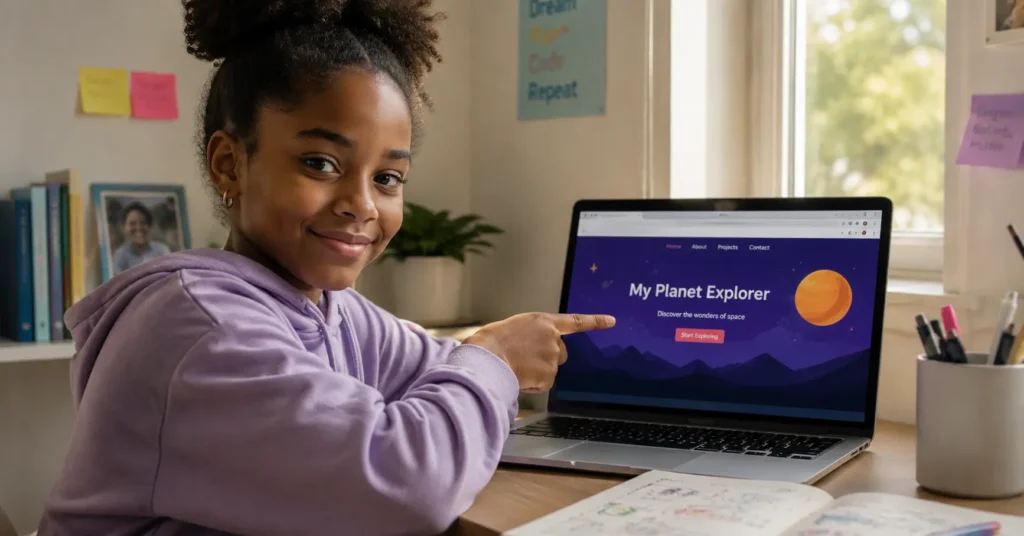
AI summer camp for kids should end with a child presenting something real. Picture the last day of a two-week programme. Your child is sitting in front of a screen, about to present something to a live audience. Not a quiz they completed. Not a certificate they received. Something they built, tested, improved, and can now explain in their own words.
That moment is Day 10 at Transcend AI Academy, and it is the point of an AI summer camp for kids built around creation. And understanding exactly how a child gets there, what they make along the way and what they walk away with, is what this article covers.
Most AI summer camp for kids descriptions tell parents what children will learn. Concepts. Skills. Exposure to tools. This article tells you what your child will actually build, day by day, across two weeks. The specifics matter because a parent choosing a programme deserves to know what they are buying, and a child deserves to know what they are signing up for.
Research on project-based learning consistently shows that children retain knowledge and develop confidence at a significantly higher rate when the learning leads to something tangible they created themselves. The AI summer camp for kids curriculum at Transcend AI Academy is built around that principle from Day 1.
Before going into the curriculum, if you are still working out which age track is right for your child, the guide on what age should kids start learning AI covers the developmental readiness question in detail. There are two tracks: AI Explorers for ages 8 to 11, and AI Innovators for ages 12 to 16. The tools are similar across both. The depth, the independence expected, and the standard applied are not.
AI Summer Camp for Kids: What AI Explorers Build Ages 8 to 11
The first week of this AI summer camp for kids carries one clear purpose: get every child creating something with AI before they build anything without it.
Day 1 opens in the AI Visual Creation Lab. Children learn to turn ideas into AI-generated visuals, characters, posters, product ideas, and story scenes. The emphasis from the first session is not on accepting what the tool produces. It is on describing what you want clearly, improving what comes back, and questioning the result rather than assuming it is finished. An 8-year-old who has spent Day 1 improving an AI-generated image rather than just accepting the first output has already learned something most adults skip.
Day 2 moves into voice and video. Children create short scripts, voiceovers, and avatars, and learn how words, images, voice, and video can work together to explain an idea in a way that is honest and responsible. By the end of the second day, a child has created visual and audio content using AI tools. They have also started to understand that AI can be directed rather than simply used.
Day 3 is where the AI summer camp for kids experience starts to feel like real building. Children use AI to plan and build a simple one-page website around a guided idea, a mini business, a story project, a club, a character, or a personal interest. They learn the structural elements of a web page: title, sections, images, description, and call-to-action. For most children in this age group, this is the first time they have built something that exists on the internet and can be shared with someone else.
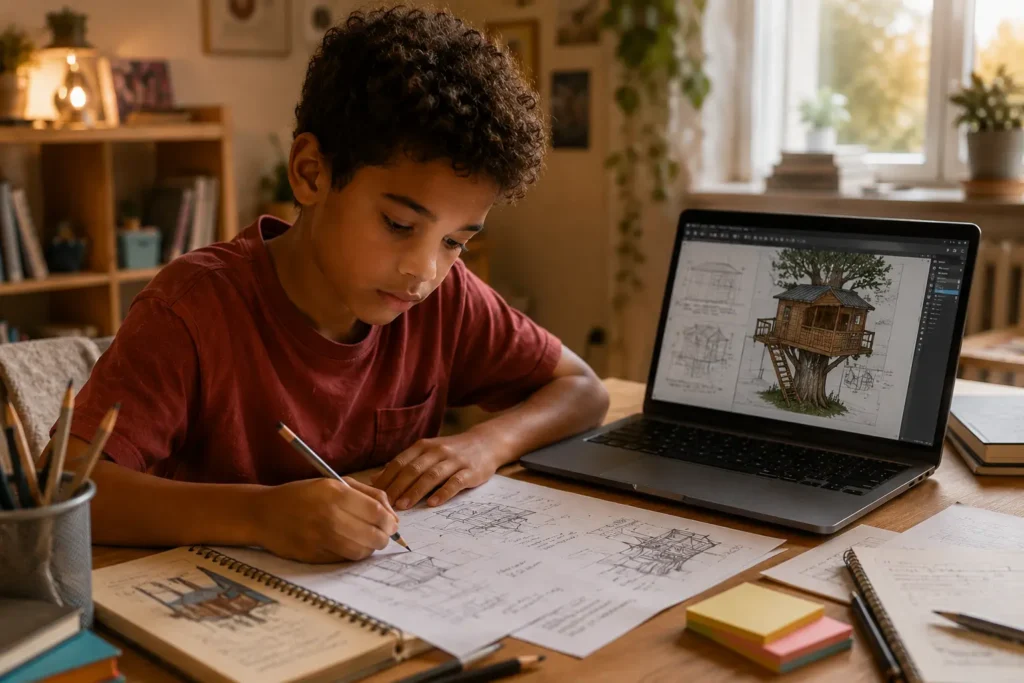
Day 4 teaches improvement rather than creation. Children return to the website they built the day before and make it clearer, better organised, and stronger visually. They learn why good digital content should be clear, honest, and safe to share. This day is quieter than Day 3 but it is where precision develops.
Day 5 introduces the category of tools that will anchor the second week: interactive web-based projects. Quizzes, guessing games, planners, idea generators, simple calculators, choose-your-own-path activities. The focus is on seeing that AI can help them build things other people can actually use.
Week 2 of the AI summer camp for kids shifts the entire frame. The first week was guided. The second week is the child’s own.
Day 6 begins the AI summer camp for kids capstone build. Children choose the direction of their final project and start building with AI support. The options are deliberately broad: a quiz, a simple game, a planner, a story path, an idea generator, or a class challenge. The choosing is part of the learning. A child who decides what they are going to build and why is exercising a different kind of thinking than a child following instructions.
Day 7 teaches something that many programmes skip entirely: how to test, find problems, and fix them. Children learn to notice what is confusing, unclear, broken, unfair, or weak in their own work. They use that feedback to improve before sharing with others. This day produces some of the most important thinking of the two weeks.
Day 8 is Capstone Project Build Day in the AI summer camp for kids curriculum. The child commits to their final direction and begins building the version they will present. The options are wide: a one-page website, a simple web-based tool, a mini game, a story showcase, a character project, a learning quiz, or a project combining visuals, voice, video, and web design. The choice is entirely theirs.
Day 9 refines and checks. Children polish their capstone, improve the design and content, and complete a simple responsible AI check. They prepare to explain what they built, how AI helped, what they changed, and which ideas came from them. This question, which ideas came from you, is central.
Day 10 is Demo Day, the moment every AI summer camp for kids should be building toward. Every AI Explorer presents a completed beginner-friendly AI project to a live audience. They walk the audience through what they created, how they used AI, what they improved, and what parts came from their own thinking. They leave with a completed project, a certificate, and a beginner-friendly creator portfolio they can proudly show.
“A child who decides what they are going to build and why is exercising a different kind of thinking than a child following instructions.”
AI Summer Camp for Kids: What AI Innovators Build Ages 12 to 16
The AI Innovators track in this AI summer camp for kids covers the same categories of work as the Explorers. The standard applied is different.
Day 1 opens in the same AI Visual Creation Lab but with a higher expectation. Innovators learn to turn ideas into AI-generated visuals while developing the habit of questioning and improving outputs. The tool is the same. The responsibility placed on the child to interrogate the result is not.
Day 2 adds a dimension that the Explorers track does not carry: the ethics of AI-generated media. Innovators create short scripts, voiceovers, and avatars while learning why responsible creators must avoid impersonation, deepfakes, and misleading content. A 14-year-old who has spent Day 2 understanding why responsible AI creation matters in the context of their own work is learning something that will stay with them.
Days 3 and 4 follow the same web design arc as the Explorers track, with the Innovators adding a layer of user experience thinking. The question on Day 4 is not just whether the website looks better. It is whether it is clearer, more trustworthy, and easier for another person to understand and use. That shift from personal to audience-focused thinking is significant.

Day 5 introduces the same category of interactive web tools, with an emphasis on useful rather than entertaining. Quizzes, planners, calculators, trackers, idea generators, onscreen games. The Innovators are thinking about what the tool does for the person using it, not just whether it works.
Week 2 of the AI summer camp for kids follows the same structure as the Explorers but with the Innovators expected to bring together AI creation, web design, and responsible use in a single capstone project. The capstone options reflect this broader scope: a one-page website for a business, product, service, or personal brand; a simple web-based tool such as a planner, quiz, calculator, or tracker; a simple onscreen game; a campaign page or awareness project; or a portfolio-style project combining visuals, copy, voice, video, and web design.
Day 7 for Innovators is titled Test, Critique, and Improve Like a Responsible Builder. The additional word matters. Innovators are expected to spot what is unclear, broken, biased, misleading, or weak in their own work. Bias is on the checklist from the start.
Day 9 for Innovators includes a responsible AI checklist as a formal part of the capstone refinement. This is not an add-on. It is a required step before the project is considered finished.
Day 10 is Demo Day in the older AI summer camp for kids track. Every AI Innovator presents a completed capstone project to a live audience. They walk the audience through the problem they chose, what they built, how they used AI, what they improved, and the responsible choices they made along the way. They leave with a completed project, a certificate, and a portfolio-style record of their work.
“A 14-year-old who has spent Day 2 understanding why responsible AI creation matters in the context of their own work is learning something that will stay with them.”
The Detail Parents Do Not Expect in an AI Summer Camp for Kids
Every AI summer camp for kids mentions responsible AI use. Most treat it as a topic covered in one session. At Transcend AI Academy it is a thread running through both tracks from Day 2.
Explorers learn to question AI outputs rather than accept them from the first session. Innovators learn the specific risks of AI-generated media on Day 2. Both tracks in the AI summer camp for kids complete a formal responsible AI check on Day 9 before their projects are considered ready to present.
A child who passes that check on Day 9 can answer a specific set of questions about their own work. Which parts came from AI and which came from them. What they changed and why. What the AI got wrong and how they addressed it. That is not a soft skill. It is a habit of mind that transfers into every future interaction with AI tools. For parents who want to understand more about whether AI use is safe for children in the first place, the article on whether AI is safe for children addresses those concerns directly.
“A child who passes that check on Day 9 can answer a specific set of questions about their own work. Which parts came from AI and which came from them.”
What a Child Takes Home from an AI Summer Camp for Kids
Three things leave the AI summer camp for kids with every child.
The completed project from the AI summer camp for kids. A real digital artefact that exists online and can be shared, shown, and pointed to. Not a simulation. Not a screenshot of someone else’s work. Something they built.
The certificate. Evidence of completion of a structured, live, instructor-led programme.
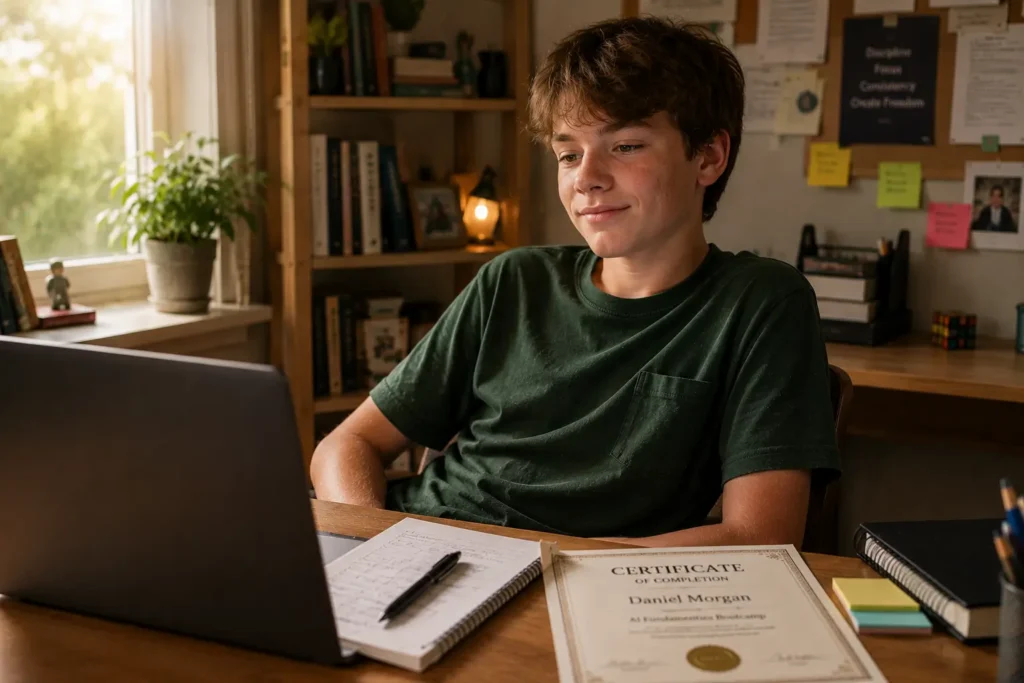
The portfolio from the AI summer camp for kids. AI Explorers leave with a beginner-friendly creator portfolio. AI Innovators leave with a portfolio-style record of their work. For a teenager applying to university in two or three years, having a documented record of AI project work completed before they were 16 is a meaningful differentiator.
The fourth thing is harder to photograph but worth naming: the habit of questioning AI outputs. A child who has spent ten days making decisions about what to keep, what to change, and what to reject from an AI tool does not go back to passive use easily. That instinct, once built, tends to stay. For a deeper look at what that development looks like over time and how parents can recognise it, the article on what AI fluency actually means for children is worth reading alongside this one.
On Day 10 of the AI Summer Camp for Kids, Your Child Presents
That sentence is either exciting or it is not.
If it is, the AI summer camp for kids is built around exactly that moment. Ten days of creating, building, testing, refining, and checking responsible use all lead to one child standing in front of an audience and walking them through something they made.
For parents who want a complete framework for evaluating whether any AI programme is worth the investment, the guide on how to choose an AI academy for kids covers every criterion in detail.
“Ten days of creating, building, testing, refining, and checking responsible use all lead to one child standing in front of an audience and walking them through something they made.”
If your child is between 8 and 16 and you want to see the full AI summer camp for kids curriculum, the session dates across three summer batches, and the enrolment details, everything is at transcendaiacademy. Click the button below.