
A few weeks ago I was speaking to a group of teenagers at a church. I asked a simple question: how many of you use AI?
Every hand went up.
So I asked a follow-up. What do you actually use it for?
Most said homework. A few said preparing for tests. Then one teenager mentioned, almost casually, that some of her friends used AI to generate fake photos of boyfriends and girlfriends to post on Instagram.
Nobody in that room had taught those teenagers how to use AI. They had simply found it, picked it up, and started using it the way teenagers use anything unsupervised. Some of it harmless. Some of it heading somewhere concerning.
That conversation is why the question parents are asking, is AI bad for kids, deserves a real answer rather than a quick reassurance.
Is AI Bad for Kids? The Direct Answer
AI is not inherently bad for children. The research backs this up. The American Psychological Association’s health advisory on AI and adolescent well-being states clearly that the effects of AI on development are nuanced and complex, and that AI is not all good or bad. The impact depends on the specific application, how it is designed, and the context in which a child uses it.
What that means in plain language is this: the same technology that helps a child understand a difficult concept, explore a creative idea, or practise a new skill can also be used to copy homework, generate misinformation, or create fake social media profiles. The technology does not decide which of those happens. The presence or absence of guidance does.
The technology does not decide which of those happens. The presence or absence of guidance does.
The Real Risks Parents Should Know About
The concerns parents carry about AI and children are not overblown. They deserve to be taken seriously.
The most commonly cited risk is overreliance. When a child turns to AI for every answer without thinking the problem through first, they miss the cognitive work that builds real understanding. Learning happens in the struggle, not in the shortcut. A child who uses AI to write every essay is not learning to write. They are learning to copy.
Privacy is a real concern too. Most AI tools collect data on users, and children are often unaware of what they are agreeing to when they start a conversation with an AI application. Younger children in particular tend to treat AI assistants as confidants, sharing personal details they would not share with a stranger.
Then there is the social dimension. The teenagers generating fake relationship photos for Instagram are not an anomaly. They represent a pattern that researchers are starting to pay attention to: children using AI to construct versions of reality that feel easier than navigating actual relationships. This is worth watching carefully as the technology becomes more capable.
These risks are real. Any honest conversation about AI and children has to say so directly.
Where the Risk Actually Lives
Here is the distinction that most articles on this subject fail to make.
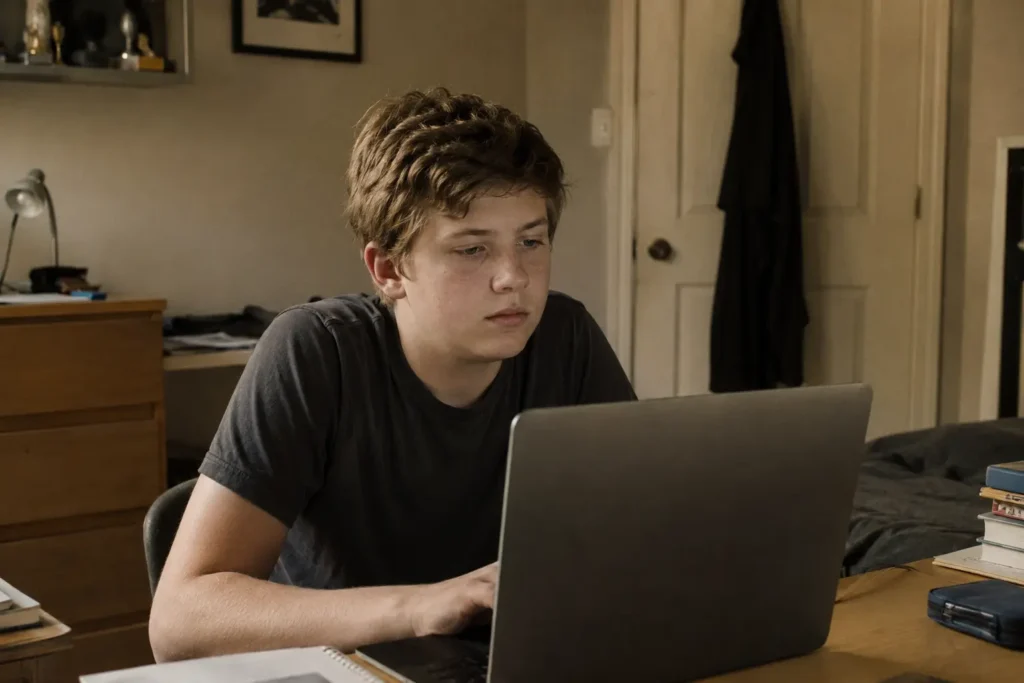
Every risk described above is a product of unguided AI use. A child alone with a tool, no context, no boundaries, no one asking what they are actually doing with it or why.
That is a very different situation from structured AI education.
When a child uses AI without guidance, they do what those teenagers did. They find the path of least resistance. Homework becomes a copy-paste exercise. Creativity becomes a prompt and a result, with nothing learned in between. Social behaviour adapts to whatever the tool makes easy.
When a child learns AI with guidance, the entire dynamic changes. They are taught to question outputs rather than accept them. They are shown how to use the tool to extend their thinking, not replace it. They learn that the first result is almost never the best result, and that improving it requires their own judgement. That process does not produce passive consumers. It produces children who understand what they are working with and can direct it deliberately.
The risks parents are reading about are genuine. They describe what happens when children encounter AI with no preparation and no adult in the room.
The risks parents are reading about are genuine. They describe what happens when children encounter AI with no preparation and no adult in the room.
What Structured AI Education Does Differently
The teenagers in that church room were not bad kids making bad choices. They were curious young people doing what curious young people do when given access to a powerful tool and no instruction manual.
Structured AI education gives them the instruction manual.
In a well-designed programme, children learn to evaluate what AI produces rather than accepting it at face value. They learn that AI predicts language and generates patterns, which means it can sound convincing while being completely wrong. That single lesson, understood properly, changes how a child relates to every AI tool they will ever use.
They also work on real projects with genuine outcomes. A child who has spent ten days building something with AI, making decisions at every stage, encountering limitations and working around them, does not come away passive. They come away with a clear sense of what the tool can and cannot do, and a much stronger instinct for when to trust it and when to question it.
Ethics and responsible use are part of the curriculum in serious AI education programmes, not an afterthought. Children discuss bias in AI outputs, the difference between AI-assisted work and AI-generated work, and why the integrity of their own thinking matters. These conversations, had early and in a structured setting, build habits that carry forward.
A child who has spent ten days building something with AI, making decisions at every stage, does not come away passive.

What Parents Can Actually Do
If your child is already using AI, the conversation to have is not whether they should stop. It is what they are using it for and how.
- Ask them to show you something they made with AI.
- Ask them what decisions they made along the way.
- Ask them what the AI got wrong and how they fixed it.
The answers to those three questions will tell you immediately whether your child is directing the tool or being directed by it.
If they are using AI for homework, the question to ask is not whether they used it, but whether they understand the material better or worse than before they used it. AI that produces an essay a child does not understand has not helped them learn anything. AI that helped them organise their thinking and then improved their own draft is a different story entirely.
For parents considering a structured AI programme, look for small class sizes where individual attention is possible. Look for live instruction rather than pre-recorded content. Look for programmes that require children to build real projects rather than just interact with tools. And look for explicit teaching around ethics and responsible use, because the child who knows how to use AI responsibly is far better protected than the child who has simply been kept away from it.
If you are still working out whether your child is the right age to start, the guide on what age should kids start learning AI walks through that question in detail.
If you want to understand more about what children actually develop when AI is taught well, the concept worth reading about is what educators call AI fluency, which we cover in detail separately.
The Goal Is Not to Keep Them Away
The teenagers who raised their hands in that church room are going to keep using AI regardless of what any parent decides. The tools are too accessible and too useful for that train to reverse.
The question is not whether children use AI. The question is whether the first serious lessons they learn about it come from a structured environment where someone is thinking carefully about their development, or from trial and error with no guardrails and no one asking the right questions.
Curiosity without guidance produced those fake Instagram profiles. Curiosity with guidance produces something very different.
Curiosity without guidance produced those fake Instagram profiles. Curiosity with guidance produces something very different.
If your child is between 8 and 16 and you want them to build a real relationship with AI, one based on understanding and directed thinking rather than passive use, you can find details about our upcoming structured programme at our AI Summer Camp. Spots are small by design, so every child gets the attention this kind of learning requires.