
Picture this. You receive a newsletter from your child’s school. It mentions ‘AI-integrated learning’ and ‘AI literacy programmes’ in the same paragraph. You read it a second time and still cannot tell whether the school is teaching your child about AI or simply using AI to teach them.
That confusion is not a sign you are not paying attention. It is a sign the terms are being used interchangeably when they describe two entirely different things. And the difference matters more than most people realise.
What AI Education for Children Actually Means
There are two distinct things happening under the umbrella of ‘AI and education,’ and most parents have never had them separated clearly.
The first is AI being used as a tool in education. This is schools using AI to personalise lesson plans, generate practice questions, or help teachers identify which students are falling behind. The child benefits from this passively. They do not need to understand what is happening behind the tool for it to help them.
The second is AI education for children as a subject in its own right. This is children learning to understand how AI works, how to direct it deliberately, how to evaluate what it produces, and how to build with it. The child is not the passive beneficiary of the tool. They are learning to be the person who knows how to use it.
Most schools are doing the first. Almost none are systematically doing the second. AI education for children, as a structured subject, is still rare. That gap is precisely why the parents who find it early are giving their children something most of their peers will not have.
What children actually learn in a well-designed AI education programme covers more than tool familiarity. They learn how AI processes information and why it produces the outputs it does. They learn to recognise when an AI output is wrong, biased, or shallow. They learn to ask better questions, refine results, and build projects that reflect their own thinking rather than the machine’s default. These are not narrow technical skills. They are thinking habits that transfer across every subject a child will ever study.
“Most schools are doing the first. Almost none are systematically doing the second.”

Why the Timing Matters
One of the students who came through 9jacodekids Academy, which Ugo Nkwocha founded in Nigeria before building Transcend AI Academy, started learning to code in junior secondary school and continued through to graduation. Years later, his mother reached out to share news. Her son was studying at a university in Canada, and his lecturers were remarking on how far ahead of the class he was. He was eventually permitted to skip certain courses entirely because his foundation was that strong.
He did not arrive at university with superior intelligence. He arrived with a foundation that had been built carefully, over years, starting at exactly the right developmental moment.
Research from Harvard’s Graduate School of Education on AI and children’s development reinforces what that story illustrates. The habits children build around technology during their formative years shape how they engage with it for the rest of their lives. A child who learns early to question outputs, direct tools, and build rather than just consume develops an instinct that compounds over time. A child who only ever uses technology passively develops a different instinct, one that is much harder to unlearn later.
The school curriculum is not keeping pace with this. Most national curricula are several years behind the technology that children are already using daily. Structured early exposure, outside the school system, is currently the only reliable way to close that gap. For a detailed look at exactly when children are developmentally ready to begin, the pillar article on what age should kids start learning AI covers this question thoroughly.
“He did not arrive at university with superior intelligence. He arrived with a foundation that had been built carefully, over years, starting at exactly the right developmental moment.”
What AI Education for Children Is Not
Before going further, three things worth clearing up.
- AI education for children is not the same as coding. Coding is about giving a computer precise instructions in a specific language. AI education is about understanding systems that learn from data and generate outputs, and learning to work with them effectively. A child can have excellent AI education without writing a single line of code. The two disciplines complement each other, but they are not interchangeable.
- It is not extended screen time. The concern that AI education means more hours staring at a device misses the point of what good AI education looks like. A child in a well-run programme is thinking, deciding, discussing, and building. The screen is a tool in the process, not the point of it. The cognitive work is happening in the child’s mind, not on the device.
- It is not replacing human learning or human teachers. AI education at its best teaches children to use AI as a thinking partner, with the child directing the partnership. The human judgement, the creative instinct, and the final decisions remain with the child throughout. If a programme is producing children who defer to the tool rather than directing it, the programme is not teaching AI education. It is teaching dependence.
What Children Gain From AI Education
The skills that AI education builds are not narrow or tool-specific. They are the kind of skills that transfer.
A child who has learned to evaluate AI outputs critically is also better at evaluating any information they encounter. A child who has learned to refine a prompt until it produces what they actually intended has also learned something about clear thinking and precise communication. A child who has built a project from start to finish using AI as one component among many has learned project management, decision-making under constraints, and how to produce something real from an idea.
These benefits compound. The child who develops these habits at age 10 arrives at secondary school with a different relationship to learning than their peers. By 16, the gap is visible. They approach complex problems differently. They are comfortable with iteration and comfortable with uncertainty. They know how to use powerful tools without being controlled by them.
For a deeper look at what this development looks like in practice, the article on what AI fluency actually means for children explores the specific signs parents can watch for.
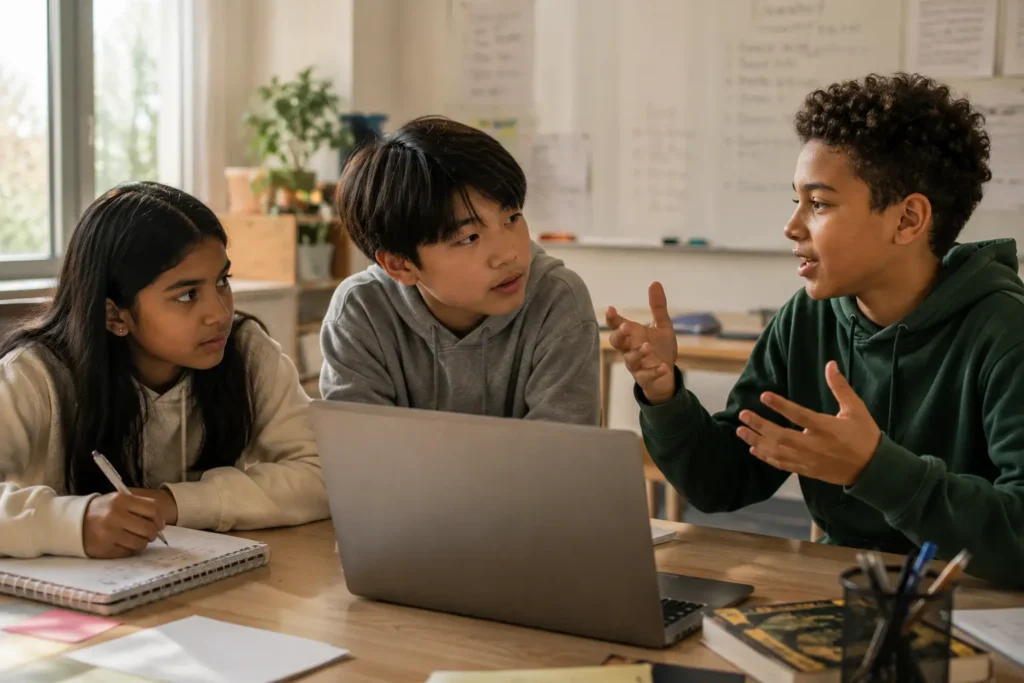
“A child who has built a project from start to finish using AI as one component among many has learned project management, decision-making under constraints, and how to produce something real from an idea.”
How to Tell Whether a Programme Is Teaching AI or Just Using It
Not everything marketed as AI education for children delivers what the name implies. Three questions cut through the noise.
- What will my child build? If there is no concrete answer to this question, the programme is not teaching AI education. It may be introducing children to AI tools, which has some value, but it is not the same thing. A child who finishes a programme with a real project they directed and can explain has had a genuinely different experience from a child who watched demonstrations and completed guided exercises.
- How small are the classes? AI education requires a thinking adult in the room who can ask each child why they made the choices they made. That conversation cannot happen in a group of thirty. Small cohorts, eight students or fewer, are not a luxury in this context. They are a requirement for the learning to actually take place.
- Does the programme address responsible use and ethics? A child who learns to use AI without understanding bias, accuracy limitations, and responsible application is only partially educated. Programmes that include these conversations as a genuine part of the curriculum, not a checkbox at the end, are producing children who will make better decisions with the technology for the rest of their lives.
If a programme answers all three questions well, your child is in the right place. If it cannot answer the first question at all, keep looking.
The Parent Who Asks the Right Question First
Understanding what AI education for children actually is changes the questions parents ask. The parent who walks into an enrolment conversation asking ‘what will my child build?’ is in a fundamentally stronger position than the parent asking ‘what tools will they use?’
The tools will change. The thinking habits built through good AI education will not.
If you are considering whether a structured AI programme is the right move for your child, the concerns parents commonly raise about AI and children are worth reading through carefully as part of that decision.
And when you are ready to look at specific programmes, a practical guide on how to choose the right AI academy for your child is coming shortly.
“The tools will change. The thinking habits built through good AI education will not.”
If your child is between 8 and 16 and you are looking for a live, structured programme that answers all three of the questions above, the details for the Transcend AI Academy summer camp. Small cohorts, real projects, and a curriculum built around understanding rather than just use.