
AI vs coding for kids is the question many parents are now asking at home. A parent I spoke with recently told me her husband had made up his mind. Their son was going to learn coding first, then AI. Coding was the foundation, her husband argued. Without it, AI education was just playing with tools.
She was not sure he was wrong. But she was not sure he was right either.
If that conversation sounds familiar, this AI vs coding for kids guide is for you. It covers what coding actually develops in a child, what AI education develops, where the ‘coding first’ argument holds up, where it does not, and what the research actually shows about which starting point makes more sense for a child between the ages of 8 and 16 in 2026.
The founder of Transcend AI Academy spent ten years teaching over 9,000 children to code through 9jacodekids Academy in Nigeria before building an AI education programme. He has watched both disciplines develop in children up close. What follows is what that experience actually shows.
AI vs Coding for Kids: What the Coding First Argument Gets Right
In the AI vs coding for kids debate, the parent pushing coding first is not wrong. Coding does build something real.
When a child learns to code, they learn to break a large problem into smaller, manageable pieces and solve them in sequence. They learn that a computer does exactly what it is told, which means if the output is wrong, the child’s instructions are wrong, and the child has to find where. That process, reading an error, forming a hypothesis, testing it, and iterating, is called debugging. Research on computational thinking consistently shows it develops logical reasoning skills that transfer well beyond any screen.
A child who has learned to code has learned something about patience with complexity. A programme that does not work the first time, the fifth time, or the tenth time, and then finally works, teaches a specific kind of persistence. These are not small things. They show up in how children approach maths problems, written arguments, and any task that requires sequential thinking.
The coding first side of the AI vs coding for kids argument also has an intuitive logic to it. If you understand how instructions work, surely you are better equipped to direct AI tools that generate code. A foundation before a superstructure.
That logic is reasonable. It is just not supported by what is actually happening in the world right now.

What the Data Says About Coding in 2026
AI now generates roughly 70 percent of code in many professional development environments. A McKinsey study published in February 2026, covering more than 4,500 developers, found that AI coding tools cut time on routine coding tasks by an average of 46 percent. By early 2026, some of Spotify’s best developers had not written a single line of code for months. Entry-level developer hiring fell 25 percent in 2024.
A parent reading those numbers might hand this AI vs coding for kids article to their spouse and say: see, coding is becoming obsolete.
That is not quite right either.
Bug density in AI-generated code without human oversight is 23 percent higher than in code with human review. Only 0 to 20 percent of coding tasks can be fully delegated to AI. Someone still decides what to build. Someone still reviews the output and catches what the machine missed. Someone still makes architectural decisions about whether the code is solving the right problem.
The developers doing that work are not the ones who type code fastest. They are the ones who understand systems, who can evaluate AI output with the critical eye of someone who has built things themselves.
Here is what this means for the AI vs coding for kids decision for a child ages 8 to 16 today.
The coding skills that are declining in value are the mechanical ones: typing syntax, writing boilerplate, producing routine functions. The skills that are increasing in value are the evaluative ones: understanding what the code should do, knowing whether AI got it right, and directing intelligent systems with clarity and judgement.
Those evaluative skills are exactly what AI education builds, which is why the AI vs coding for kids question is really about sequence, not superiority. The parent arguing for coding first is protecting a foundation that AI is already building on top of. The parent arguing for AI education first is building the skills that make that foundation matter.
“The parent arguing for coding first is protecting a foundation that AI is already building on top of. The parent arguing for AI education first is building the skills that make that foundation matter.”
What AI Education Teaches Children That Coding Does Not
In the AI vs coding for kids comparison, this is the important difference: when a child learns to work with AI, they are not giving instructions to a predictable system. They are directing a system that generates outputs based on patterns, and those outputs are sometimes excellent, sometimes wrong, sometimes biased, and sometimes convincingly wrong. The skill being built is not precision. It is judgement.
A child in a well-run AI education programme learns to describe what they want clearly, evaluate what comes back critically, identify when the output is not what they intended, and improve the result through deliberate iteration. They develop what educators call AI fluency, the ability to think with AI rather than simply use it.
For a detailed look at what AI fluency actually means and how parents can recognise it developing, the article on what AI fluency looks like in practice covers this in depth.
AI education also develops something the AI vs coding for kids debate often misses: responsibility. A child who learns AI properly understands that these tools can be wrong, can reflect bias from the data they were trained on, and can be used in ways that cause harm. A well-designed AI curriculum treats responsible use as a thread running through everything, not a session tagged on at the end.
To understand what AI education for children actually involves at its best, the article on what AI education really means goes into this in detail.
“The skill being built is not precision. It is judgement.”
Why AI Education Is the Better Starting Point for Ages 8 to 16 Right Now
AI vs coding for kids should not be framed as a fight between competitors. Coding and AI education are complementary disciplines that develop different thinking skills. They are complementary disciplines that develop different thinking skills. The real question is not which one is better. It is which one gives a child of 8 to 16 the most relevant and accessible foundation right now, in 2026, in the world they are already living in.
AI tools are already in their daily lives. They encounter them in search results, homework helpers, image generators, music tools, and social platforms. A child who learns to direct those tools deliberately, question what comes back, and use them to build something real has developed a skill with immediate application. They do not need a programming foundation to begin.
In practical AI vs coding for kids decisions, coding remains deeply valuable, and starting it alongside or after AI education strengthens both disciplines. A child who has learned to think critically about AI outputs and then learns to code develops a richer understanding of both, because they can see how each informs the other. The sequence does not have to be either/or. But if a parent is choosing where to start with a child between 8 and 16, AI education is the more natural and accessible entry point.
For the developmental question of when a child is ready to begin, the guide on what age should kids start learning AI covers this in detail.
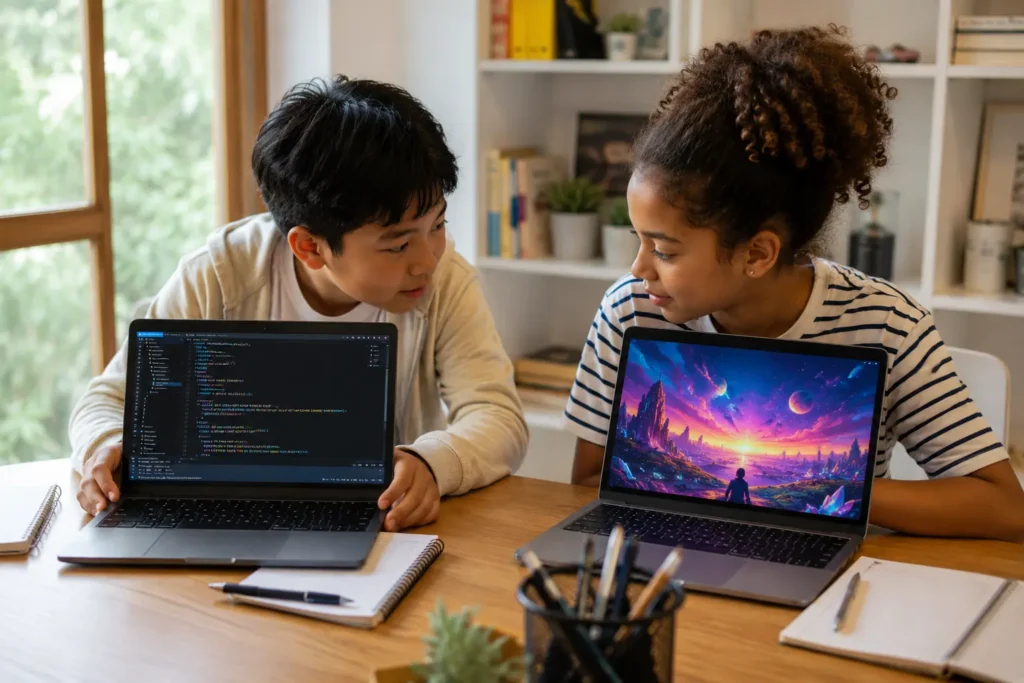
What to Say to the Spouse Who Wants Coding First
Coding first is not a bad call in the AI vs coding for kids conversation. It is just not the only call, and for most children in this age range, it is not the most immediate one.
The children who will be most capable in the working world of the 2030s are not the ones who learned the most code. They are the ones who can direct intelligent systems with clarity, evaluate outputs critically, build things that work, and take responsibility for how the tools they use affect other people. That profile describes the outcome of good AI education. Coding, introduced alongside or after, deepens it.
In the AI vs coding for kids conversation, the spouse who wants coding first has the right instinct: give the child something rigorous and structured, not just access to tools. That instinct is correct. The question is whether coding is the most rigorous and structured starting point available to a child ages 8 to 16 right now, or whether a well-designed AI education programme delivers that rigour in a context that is more immediately relevant to the world the child is already navigating.
For parents who want a practical framework for evaluating any AI programme and comparing it against what is available, the guide on how to choose an AI academy for kids covers the criteria in detail.
“The spouse who wants coding first has the right instinct: give the child something rigorous and structured, not just access to tools. That instinct is correct.”
The Conversation Worth Having at Home
The parent who came to me with her husband’s coding-first view was not facing a disagreement about values. Both parents wanted the same thing: a child who is capable, critical, and prepared. The disagreement was about the route, which is the real heart of the AI vs coding for kids decision.
Both routes lead somewhere good, so AI vs coding for kids is ultimately a sequencing question. The question is which one your child can start today, at their age, with the tools and programmes available to them right now, in a way that builds the habits that will matter most when they reach their twenties.
For most children between 8 and 16, the answer to AI vs coding for kids is AI education, with coding as a natural next chapter rather than a mandatory prerequisite.
“Both routes lead somewhere good. The question is which one your child can start today, at their age, with the tools and programmes available to them right now.”
If your child is between 8 and 16 and the AI vs coding for kids question has led you toward a structured, live AI education programme where they build real projects in small cohorts, the details for Transcend AI Academy’s upcoming summer camp are in the button below. Spots are small by design, so every child gets the attention this kind of learning requires.