
Online AI summer camp options can be hard to compare with in-person programmes because both can look credible on the surface. You have two AI summer camps on your shortlist. One is a week on a university campus in another city, residential, with labs and peer socialisation and the full camp experience. The other runs live online over two weeks, small groups, from your child’s desk at home. Both look credible. Both claim real projects and experienced instructors.
The question sitting in your browser tab is simple: if you choose an online AI summer camp over a campus programme, what would you actually be giving up with each choice?
This article answers that honestly. Before going into the comparison, if you are still working out what age is right for your child to start AI learning, we cover that separately here. Once that is settled, the format question is the right one to be asking.
What the In-Person AI Summer Camp Experience Actually Looks Like
In-person AI camps have real advantages, and they deserve an honest description.
The campus environment carries genuine weight for some children. Being away from home, living and learning alongside peers who share the same interests, eating in a dining hall, exploring a university campus, these experiences build independence and social confidence in ways that a two-week online programme simply does not. For a teenager who has never spent time away from home, the non-academic elements of an in-person camp can be as valuable as the curriculum.
The immersion is also real. A child who is fully present at a residential camp, with nothing to distract them except the work and the people around them, can go deeper in a week than a child splitting their attention between camp sessions and home life. The single-environment focus has learning value.
Those are the genuine advantages. Here are the practical realities.
The largest and most established in-person AI camps operate almost exclusively in the United States. For families in Canada, the UK, or anywhere else internationally, travelling to attend a quality residential programme means flights, accommodation, and weeks away from home on top of the camp fee itself. The total cost can reach several thousand dollars before the learning even begins.
Availability is also a constraint even within the US. Quality residential AI camps fill quickly, often by March or April, and options outside major cities are limited. A family in a smaller Canadian city or a rural UK town may simply not have a viable in-person option within reasonable distance.
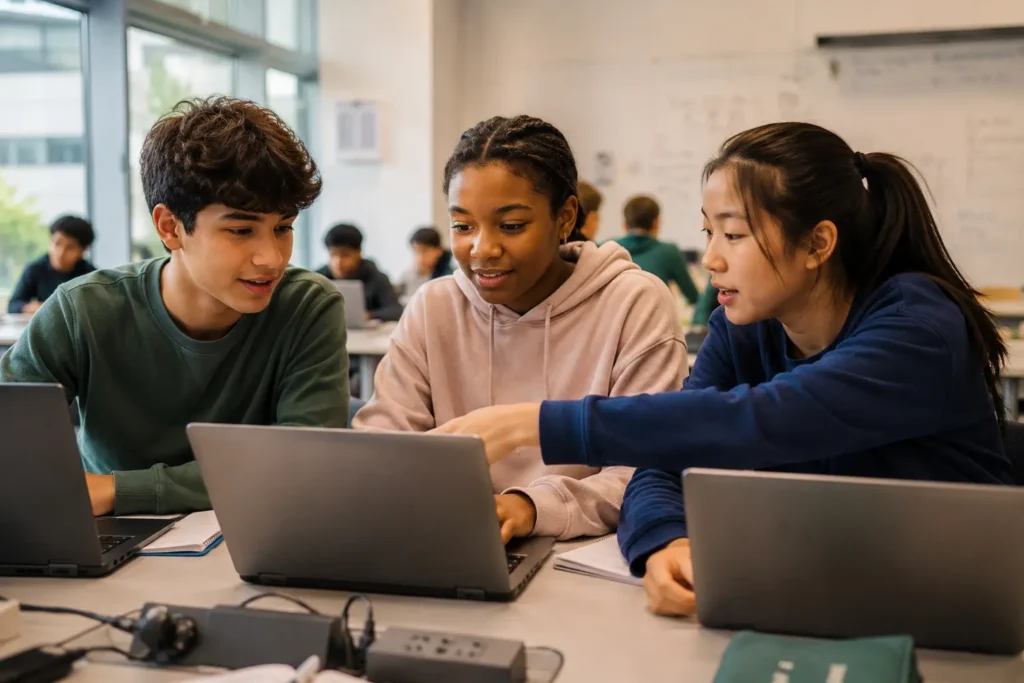
“For a teenager who has never spent time away from home, the non-academic elements of an in-person camp can be as valuable as the curriculum.”
What a Well-Run Online AI Summer Camp Delivers
The most important thing to understand about an online AI summer camp is that the format question is separate from the quality question. A poorly run online programme and a well-run one share nothing in common except the delivery mechanism. What matters is whether the live element is genuine.
Research on what makes online learning effective for children consistently points to the same factors: real-time interaction with an instructor, small group sizes that allow individual attention, and structured project outcomes that require active participation rather than passive watching. A live online AI summer camp session where an instructor can see a child’s screen, ask them why they made a particular choice, and respond to that answer in real time is not a compromise version of in-person learning. It is a different version of the same thing.
For AI education specifically, an online AI summer camp carries a genuine structural advantage. To understand why, consider what children are actually learning. AI tools are accessed and used online. The skills they are building, prompting, evaluating outputs, building projects, applying AI to problems, are all applied in a digital environment. A child developing these skills in a live online session is working in exactly the context where those skills will be used. The format is native to the subject in a way that is not true of most other disciplines.
To understand what AI education for children actually involves at its best, the article on what AI education really means lays this out in detail.
The geographic access point also belongs here. For families in Canada, the UK, and internationally, a quality online AI summer camp is not a second choice. It is the only realistic way to access this kind of education at all. Online removes the geography barrier entirely. A child in Hamilton, Ontario, or Edinburgh, Scotland, or Lagos, Nigeria, can join the same live session with the same instructor as a child in Toronto or London. That access is not a lesser version of something better. It is the thing itself, available without a plane ticket.
“Online removes the geography barrier entirely. A child in Hamilton, Ontario, or Edinburgh, Scotland, or Lagos, Nigeria, can join the same live session with the same instructor as a child in Toronto or London.”
Where Each Format Has a Real Advantage
In-person is the right choice when the non-academic experience is a primary goal. A teenager who would benefit from time away from home, from building friendships in a shared residential environment, from the confidence that comes with navigating a new place independently, may gain as much from the camp experience as from the AI curriculum. If your child is ready for that kind of independence and you have the means and the geographic access to make it happen, a quality residential programme is worth considering seriously.
An online AI summer camp is the right choice when the learning itself is the primary goal and the family is based outside the US, when the schedule needs to fit around other summer commitments, when cost is a meaningful consideration, or when the child learns better in a familiar environment with access to their own space and routine. For most families in Canada, the UK, and internationally, online is also simply the only option that does not require significant travel investment.
The online AI summer camp versus in-person decision often makes itself once you are honest about your family’s actual situation.
What to Look for in an Online AI Summer Camp Specifically
Not every online AI summer camp is built the same way. The format can accommodate excellent learning or it can become a glorified video playlist with occasional live check-ins. The non-negotiables for a quality online programme are live instruction throughout every session, class sizes small enough that the instructor knows each child’s name and work, and a clear project outcome the child builds and can explain by the end.
For a complete framework covering everything to evaluate in any AI programme regardless of format, the guide on how to choose an AI academy for kids covers the full criteria in detail.
Two questions specific to the online AI summer camp format are worth adding to that list. First: can the instructor see the child’s screen during sessions? This is the simplest indicator of whether live interaction is genuine. An instructor who cannot see what a child is working on cannot give meaningful feedback on it. Second: are sessions designed around live participation or are recordings provided as the primary option? A programme designed around live participation signals that the live element is the actual product, not a marketing claim.
For parents who are still weighing whether AI education is appropriate for their child at all, the article on whether AI is safe for children addresses those concerns directly.

The One Thing That Matters More Than Format
After all of this, the honest conclusion is straightforward.
The format is the container. What goes inside it is what your child carries home.
A child who spends a week on a university campus in guided AI sessions of genuine depth will leave with more than a child who attended a residential camp where AI was a theme rather than a rigorous subject. A child who spends two weeks in a live online AI summer camp programme with a skilled instructor, eight classmates, and a real project to build will leave with more than a child who watched pre-recorded videos from a desk at home.
The questions from the choosing guide apply regardless of format. What will my child build? How small are the classes? How are instructors selected? How is responsible AI use taught? Does the programme show me examples of what previous students made? A programme that answers all five questions well, whether it is an online AI summer camp or an in-person option, is a programme worth the investment.
“The format is the container. What goes inside it is what your child carries home.”
If your child is between 8 and 16 and you are looking for a live online AI summer camp with small cohorts and real project outcomes, see the details for Transcend AI Academy’s upcoming summer sessions by clicking the button. Three batches across July and August. Every session is designed around creation rather than consumption, from wherever your family is based.